
American businesses are lobbying with political parties here to build a consensus on stalled economic reforms such as liberalisation of foreign direct investment (FDI) in sectors like multi-brand retail, aviation and insurance, and for expeditious introduction of a Goods and Services Tax (GST).

A few companies continue to pay taxes at 15-20%.

Cohn served as Trump's chief economic advisor since the beginning of the Administration. During his stay at the White House, he led coordination of Trump's pro-growth domestic and global economic policy agenda, including the passage of historic tax cuts and reforms in December 2017, the official said.

The government is likely to increase the number of transactions that require reporting from seven to tighten scrutiny and check evasion.

Reform ideas do not occur overnight and evolve over the years.

Companies in China, South Korea and Indonesia pay 25 per cent tax, while those in Malaysia pay 24 per cent. Only Japan has a higher tax than India at 30.6 per cent. Hong Kong has the lowest corporate tax rate of 16.5 per cent while Singapore has 17 per cent rate and Thailand and Vietnam levy 20 per cent tax on companies.

Called the US Citizenship Act of 2021, the legislation modernises the immigration system, and also proposes to eliminate the per country cap for employment-based green cards, a move that would benefit thousands of Indian IT professionals whose current wait period for legal permanent residency runs into several decades.
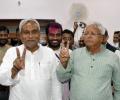
The government needs to take positive action to reaffirm that story.

The Centre has taken a major step towards increasing efficiency in decision-making by empowering joint secretaries to report to secretaries directly, officials said on Wednesday.

'One wishes that today's 'take no prisoners' brand of politics would give way to an understanding of the national interest that is shared by both government and Opposition.'

The economic reforms started by Singh as the finance minister in 1991 gave a new direction to India as it ushered in a liberal economy, Gadkari said.
India has a very low tax/GDP ratio by world standards.

Public sector banks' cumulative profit crossed the Rs 1 lakh crore-mark in the financial year ended March 2023, with market leader State Bank of India (SBI) accounting for nearly half of the total earnings. From posting a total net loss of Rs 85,390 crore in 2017-18, the Public Sector Banks (PSBs) have come a long way as their profit touched Rs 1,04,649 crore in 2022-23, according to an analysis of their financial results. These 12 PSBs witnessed 57 per cent increase in total profit compared to Rs 66,539.98 crore earned in 2021-22.
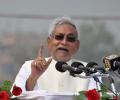
Bihar became the first non-NDA state and overall second after the BJP-ruled Assam to pass GST bill.
Finance Minister Jaswant Singh said on Wednesday the value-added tax system cannot be implemented across the country until all preparations are completed.

The challenge is to enhance opportunities for people to generate livelihoods through entrepreneurship, both big and small, argues R Jagannathan.

'GST will increase the volume of taxation, there is no tax on tax and therefore makes goods, commodities and services little cheaper and far more convenient.'
The recommendations by Shome are significant as they have been made at a time when two major tax reforms, the Goods and Services Tax and the Direct Taxes Code, have made no headway.

'With 1.3 billion consumers, India's market has great potential.'

'Everyone knows there is no point in contesting elections from Gujarat as a Congress candidate because they know they will be wiped out.'

The benefit coming in from the Rs 1.45 lakh crore tax giveaways will also help companies to cut prices by up to 5 per cent to boost consumer demand, which has been sagging and is one of the prime reasons for the deepening slowdown.

HUFs are not used for tax evasion but for tax avoidance/to save the tax within the four corners of the law. Experts say that there will be little or almost insignificant change in tax revenues.

The amendment would help check round-tripping of funds and boost the domestic consumption, Jaitley added
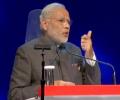
"Reform is not an end in itself. Reform for me is just a way station on the long journey to the destination. The destination is the transformation of India," he said.
'The one sector where there is still a sense of crisis is banking, but the government has regrettably set its face against privatising any of the government-owned banks,' says T N Ninan.
"Income tax revolution is going to take place. There is no limit to reforms in the income tax department and in the country as a whole," Central Board of Direct Taxes member B Swarup said in New Delhi.

Entry of a higher number of technocrats, an appraisal system for civil servants and the benefits of changing the financial year may feature in the PM's fourth speech.
The web page also enables filing of grievances in relation to the implementation of GST

The recommendation, if implemented, is likely to face opposition from the government's key support base among Hindu traders and businesspersons.
There is a need for tax reforms in the country in a bolder way, Singh said.

Stocks of public sector undertakings (PSUs) have been on fire in the past year as investors cheered an improvement in key operating metrics and embraced counters of these state-owned enterprises, analysts suggest. The S&P BSE PSU Index has gained over 90 per cent in the past year, rising much higher than the S&P BSE Sensex, which has rose nearly 19 per cent during this period, according to ACE Equity data. The BSE PSU Index, reports show, has delivered a compound annual growth rate (CAGR) of 28 per cent (including dividends reinvestments) over five years and risen by almost 60 per cent in the past year.

Per capita income has more than doubled to Rs 1.97 lakh in around nine years. Indian economy has increased in size from being 10th to 5th largest in the world in the past nine years. Seven priorities of the Budget, 'Saptarishi', are inclusive development, reaching the last mile, infrastructure and investment, unleashing the potential, green growth, youth power and financial sector.

Prime Minister Narendra Modi on Monday reviewed the situation and favoured pushing ahead with the reforms agenda and taking more steps to strengthen the economy.

Small scale and cottage industries which are labour intensive will be severely hit.
The Budget loosened the reins on public spending to drive growth.

The Budget is remarkably coherent.
Alarmed at the deteriorating financial health of states, World Bank on Tuesday suggested sweeping reforms including early introduction of value-added tax, expenditure control and other fiscal discipline measures to eliminate their revenue deficit by

Prominent among the wish list include updating India-US bilateral tax treaty, emanation of double taxation on software revenue, 15 year tax holiday for software technology parks and special economic zones.
 © 2026 Rediff.com - Advertise with us - Disclaimer - Privacy Policy - Sitemap - Feedback - About us - Terms of use - Grievances